About variable capacitors, which are essential for tuned circuits
In a
tuned
circuit consisting of a coil and a variable capacitor, even if the Q
value of the coil is high, unless the Q value of the variable capacitor
is also appropriate, performance cannot be achieved.
Comparison of air variable capacitors and poly variable capacitor
Air variable capacitor only have air between the metal pieces and an
insulator that supports the metal pieces.
Therefore, an ideal Q value can be obtained.
Poly variable capacitor are made smaller by sandwiching an insulating
sheet between metal pieces.
Some people say that the performance of poly variable capacitor is not
very good compared to air variable capacitor.
So what actually happened?
So I thought I'd compare them, but unfortunately I don't have anything
with the same capacity.
For example, if the manufacturer's variable capacitor is 430PF, the Q
value is measured at 100PF or 200PF.
I compared the Q value of air variable capacitors and poly variable
capacitors at 1MHz.
I used a variable capacitor that I had as a sample, but used variable
capacitors or variable capacitors that have been used for a long time
tend to have a lower Q value.
This is especially the case if there is dust stuck between the blades
of the air variable condenser.
Do you mistakenly believe that even if the air variable capacitor has
dust stuck between its blades, it will perform better than a poly
variable capacitor?
Poly variable capacitors have an advantage over air variable capacitors
when it comes to dust when it comes to sealed objects.
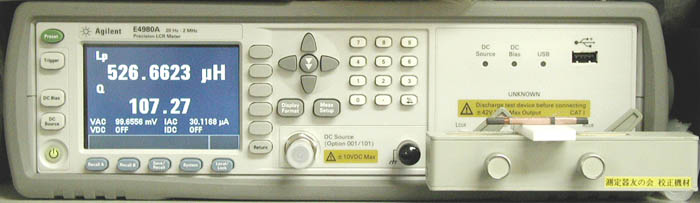
Comparison of Q value at 1MHz using Agilent (Keysight) E4980A LCR METER.
Left side: Used 430PF / 3-unit variable capacitor, New
430PF / 2-unit variable capacitor,
Used 2-channel AM / FM variable capacitor, New poly variable capacitor
Measurement frequency: Measured under the same conditions of
1MHz / 1V.

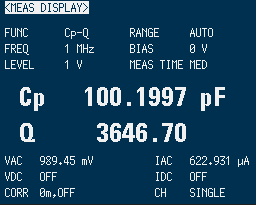
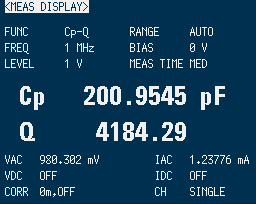
This data is for a new
430PF/double variable capacitor (Alps C624A).
The performance is outstanding!
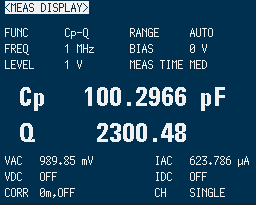
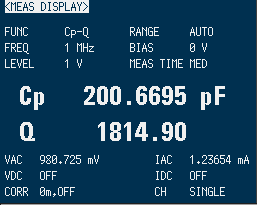
This data is polyvaricon.

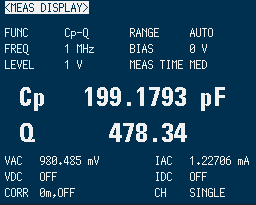
This data is for a used
430PF/triple variable capacitor.
A decrease in Q value was observed.
You can see dust between the blades, so this may be one of the causes.
Since there are no new copies of the same item,
I can't draw a definitive conclusion, but I'm sure you can't go wrong.
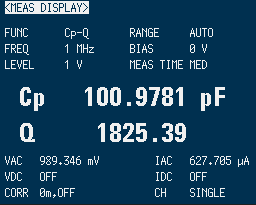
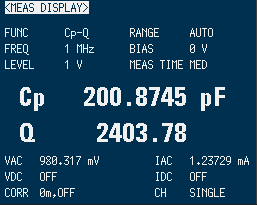
I tried removing dust with a soft, thin brush between
the blades of a used triple variable capacitor.
I don't know if the dust near the middle of the blade still remains,
but the Q value has increased considerably.
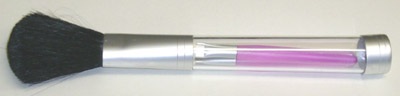
Use a thin, soft makeup brush
Since dirt is the enemy of air variable capacitors, we recommend cleaning them frequently.